
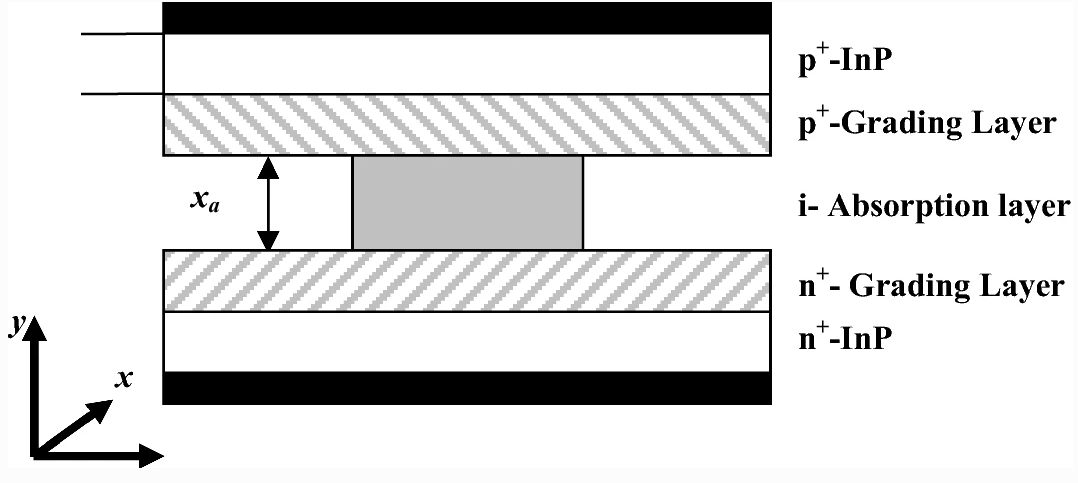
Stochastic modeling of mushroom—waveguide photodetectors
Waveguide photodetectors (WGPDs) are one of the promising candidates to solve the tradeoff between the quantum efficiency and the transit time in the surface illuminated photodiodes where the lightwave is incident laterally perpendicular to the direction of the flow of generated carriers, enhancing both high speed and quantum efficiency. In Mushroom-WGPDs, the performance degradation due its parasitic capacitance and the load resistance is overcome due to the mesa mushroom structure. Inaccuracies in the dimensions of’Mushroom-WGPDs due to the fabrication affect its functionality and its
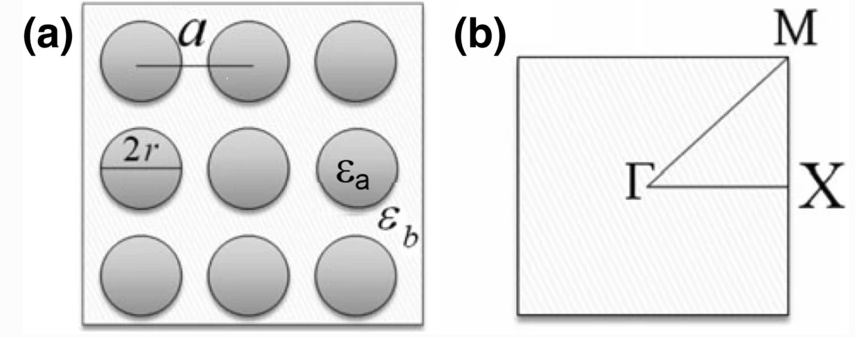
Stochastic modeling of 2D photonic crystals
Due to the fabrication processes, inaccurate manufacturing of the photonic crystals (PCs) might occur which affect their performance. In this paper, we examine the effects of tolerance variations of the radii of the rods and the permittivity of the material of the two-dimensional PCs on their performance. The presented stochastic analysis relies on plane wave expansion method and Mote Carlo simulations. We focus on two structures, namely Si-Rods PCs and Air-Holes PCs. Numerical results show—for both structures—that uncertainties in the dimensions of the PCs have higher impact on its photonic
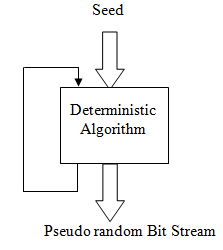
Multiplierless chaotic Pseudo random number generators
This paper presents a multiplierless based FPGA implementation for six different chaotic Pseudo Random Number Generators (PRNGs) that are based on: Chua, modified Lorenz, modified Rössler, Frequency Dependent Negative Resistor (FDNR) oscillator, and other two systems that are modelled using the simple jerk equation. These chosen systems can be employed in high speed applications because they don't utilize any hardware multiplier. The proposed PRNGs have been implemented using VHDL, synthesized on Xilinx, using the FPGA: XC5VLX50T, and tested using the NIST statistical suite. Furthermore, a

Fractional canny edge detection for biomedical applications
This paper presents a comparative study of edge detection algorithms based on integer and fractional order differentiation. A performance comparison of the two algorithms has been proposed. Then, a soft computing technique has been applied to both algorithms for better edge detection. From the simulations, it shows that better performance is obtained compared to the classical approach. The noise performances of those algorithms are analyzed upon the addition of random Gaussian noise, as well as the addition of salt and pepper noise. The performance has been compared to peak signal to noise
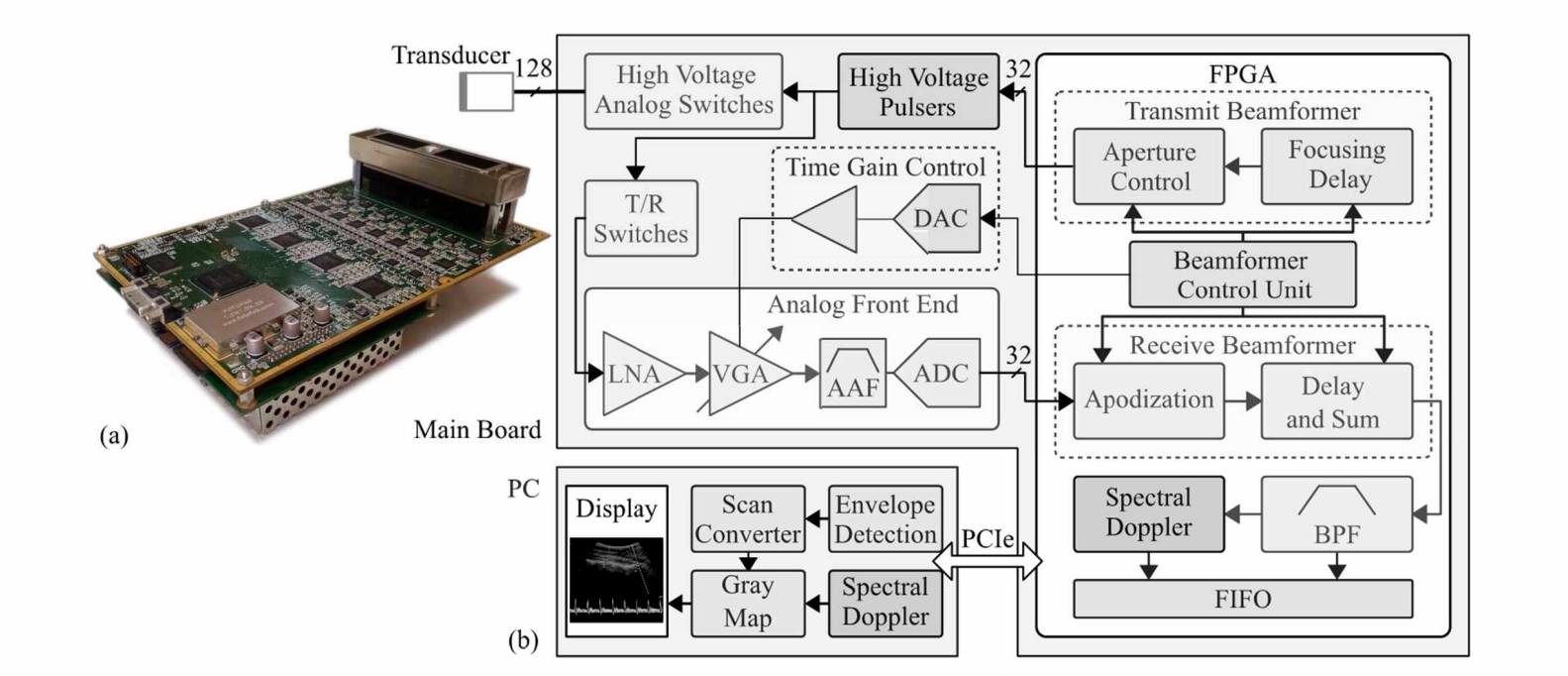
Implementation of a Pulsed-Wave Spectral Doppler Module on a Programmable Ultrasound System
Pulsed wave Doppler ultrasound is commonly used in the diagnosis of cardiovascular and blood flow abnormalities. Doppler techniques have gained clinical significance due to its safety, real-time performance and affordability. This work presents the development of a pulsed wave spectral Doppler module, which was integrated into a reconfigurable ultrasound system. The targeted system adopts a hardware-software partitioning scheme where an FPGA handles the front-end and a PC performs the back-end. Two factors were considered during the design. First, the data transfer rate between hardware and

Study of Energy Harvesters for Wearable Devices
Energy harvesting was and still an important point of research. Batteries have been utilized for a long time, but they are now not compatible with the downsizing of technology. Also, their need to be recharged and changed periodically is not very desirable, therefore over the years energy harvesting from the environment and the human body have been investigated. Three energy harvesting methods which are the Piezoelectric energy harvesters, the Enzymatic Biofuel cells, and Triboelectric nanogenerators (TENGs) are being discussed in the paper. Although Biofuel cells have been investigated for a
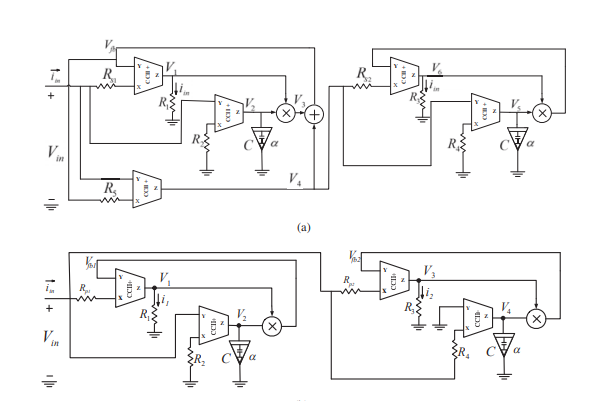
Study of fractional flux-controlled memristor emulator connections
In this paper, the series and parallel connections of the fractional flux-controlled memristors are studied. Asymmetric I-V hysteresis with high I-V nonlinearity can be obtained from single fractional memristor as reported in literature. However, connecting different memristor emulators can convert the asymmetric hysteresis to symmetric one and maintaining the high I-V nonlinearity to be used in some memristor devices. The proposed circuits have been analyzed mathematically to study the effect of changing the frequency and fractional power. Different cases have been verified on PSpice using
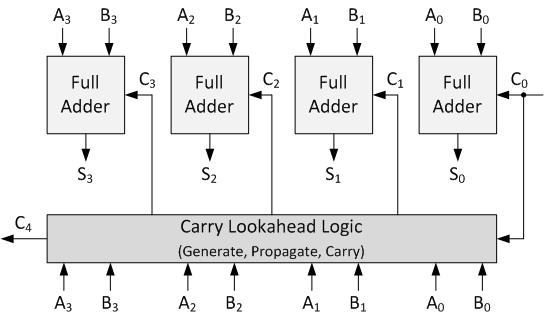
N-digits ternary carry lookahead adder design
Carry lookahead adders (CLAs) are extensively used in digital circuits due to their logarithmic computational time (O(log n)) compared to linear computational time(O(n)) in the ripple carry adders. In this paper, two design approaches for N-digits ternary logic CLA based on K-map and threshold logic methods are proposed in addtion to their realization using CNTFETs only and memristor with CNTFETs. Finally, 4-bit ternary CLA is presented. A comparison and tradeoffs among the proposed designs are presented in terms of the delay and the area. The comparison shows that the transistor-only-based
Incremental Grounded Voltage Controlled Memristor Emulator
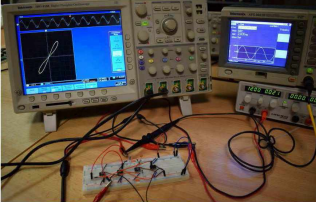
Memristor has become an interesting research subject in the recent years. Its special behavior has attracted the attention of the research community that motivated researchers to investigate it in details. As memristor is a relatively new electrical element, it is not yet available in the market as a solid state component Researchers found their way to build memristor emulators to achieve its pinched hysteresis. While many papers proposed floating emulators, only a few papers presented a grounded one. In this paper, an incremental grounded memristor emulator is proposed. The mathematical model

Logistics 4.0 technologies in agriculture systems: Potential impacts in the sdg
Agriculture systems in developing countries have been characterized by a low technology level. The principal reasons are the high cost of technologies and the difficulties to integrate the systems with the dynamics of the current business world. However, these kinds of systems have been gaining importance, mainly, for achieving the Sustainable Development Goals. This sector is relevant mainly in three specific goals: Zero hunger (goal 2), Clean water and sanitation (Goal 6) and Life on land (Goal 15). An alternative to advance this purpose is the implementation of Logistics 4.0 technologies