
CellNet:A bottom-up approach to network design
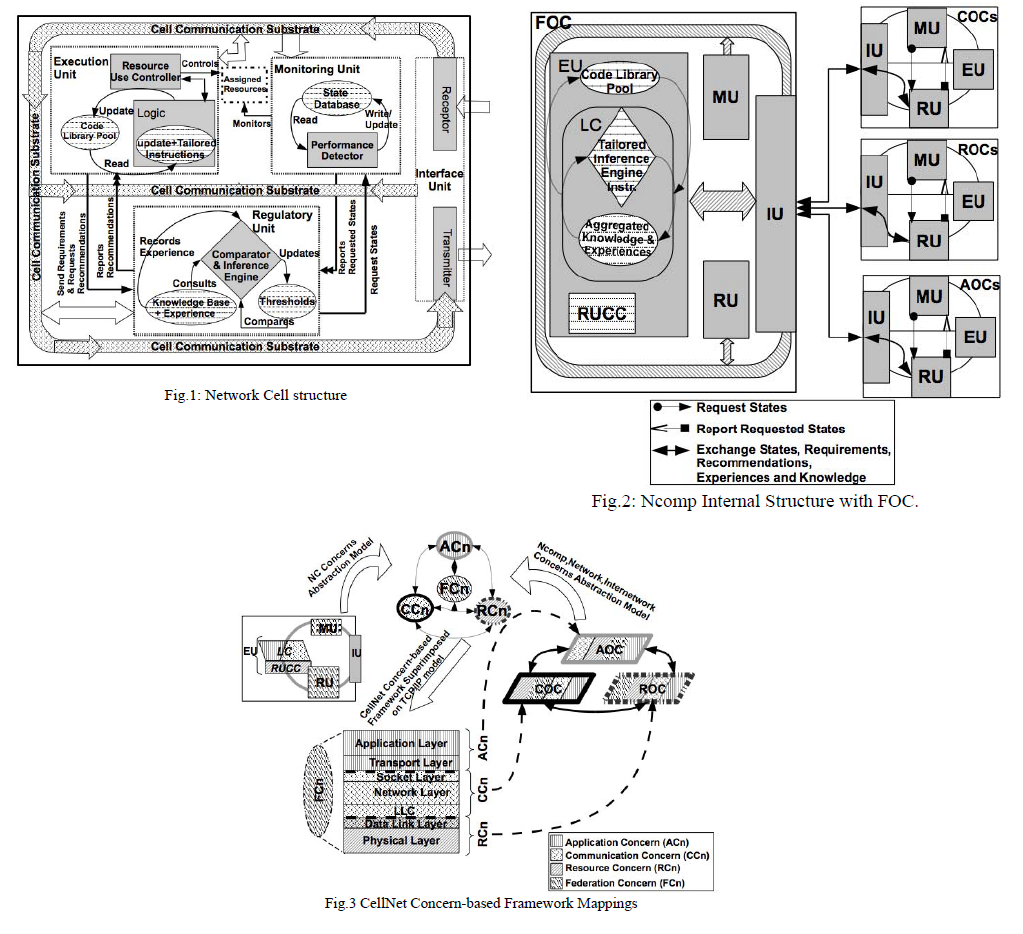
The ever-increasing dependence on the Internet is challenged by several factors impeding the smooth transition to the nomadic and ubiquitous future communications. These hindering factors are primarily attributed to the top-down approach in designing computer networks that resulted in adopting a layered architecture for abstracting network functionalities as well as for engineering protocols; a methodology that proved to be neither adaptable nor evolvable in response to changes in network operational requirements and technological advancements. This paper presents a bottom-up1 strategy for
Cognitive access protocol for alleviating sensing errors in cognitive multiple-access systems
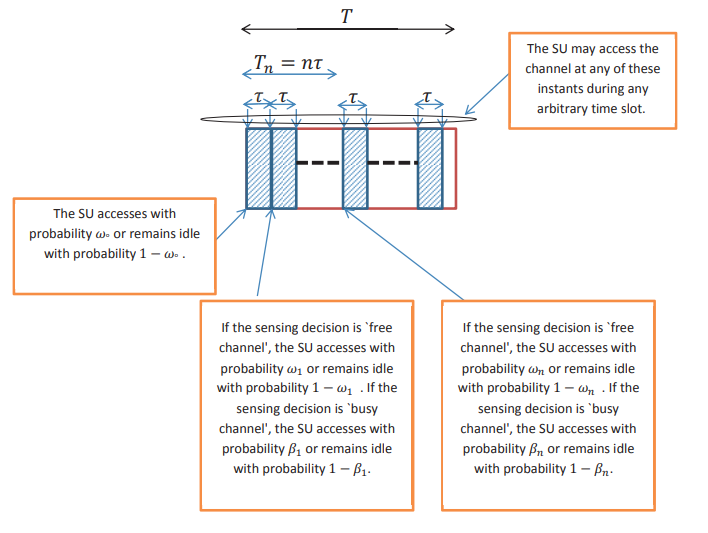
This letter studies a time-slotted multiple-access system with a primary user (PU) and a secondary user (SU) sharing the same channel resource. We propose a novel secondary access protocol which alleviates sensing errors and detects the availability of primary channels with the highest ability of detection. Under the proposed protocol, the SU may access the channel at one of a predefined instants within the time slot each of which associated with a certain access probability that changes based on the sensing outcome. There is also a possibility of accessing the channel at the beginning of the
Cooperative cognitive relaying with ordered cognitive multiple access
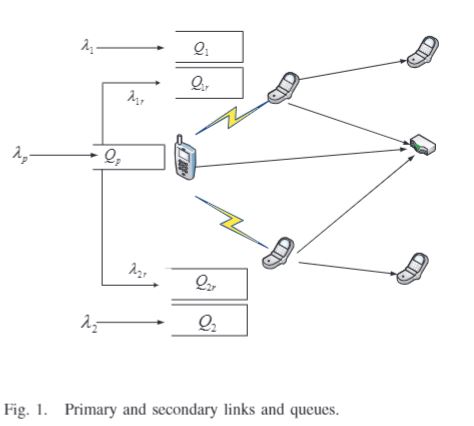
We investigate a cognitive radio system with two secondary users who can cooperate with the primary user in relaying its packets to the primary receiver. In addition to its own queue, each secondary user has a queue to keep the primary packets that are not received correctly by the primary receiver. The secondary users accept the unreceived primary packets with a certain probability and transmit randomly from either of their queues if both are nonempty. These probabilities are optimized to expand the maximum stable throughput region of the system. Moreover, we suggest a secondary multiple
Optimal selection of spectrum sensing duration for an energy harvesting cognitive radio
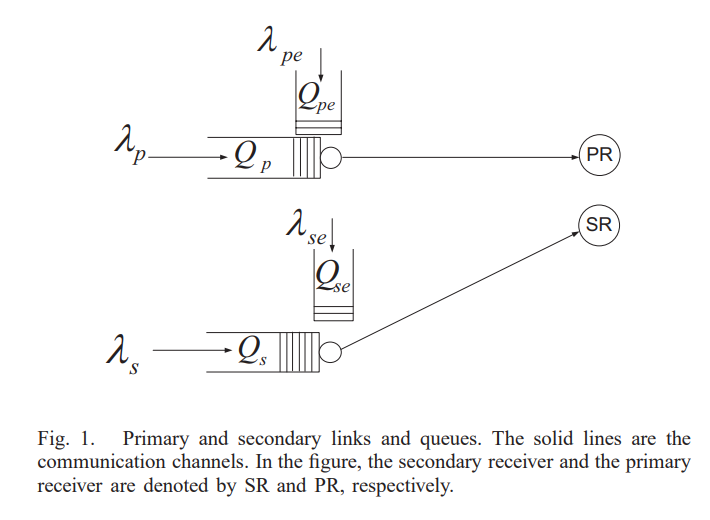
In this paper, we consider a time-slotted cognitive radio (CR) setting with buffered and energy harvesting primary and CR users. At the beginning of each time slot, the CR user probabilistically chooses the spectrum sensing duration from a predefined set. If the primary user (PU) is sensed to be inactive, the CR user accesses the channel immediately. The CR user optimizes the sensing duration probabilities in order to maximize its mean data service rate with constraints on the stability of the primary and cognitive queues. The optimization problem is split into two subproblems. The first is a
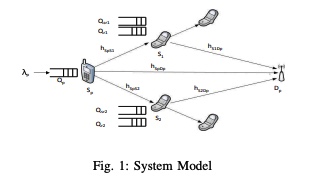
A dynamic relaying scheme for cognitive networks with multipacket reception capability
We study a cognitive radio system where the secondary users can relay the unsuccessful packets of the primary user. We study a model with one primary link and two secondary links with Multipacket Reception capability (MPR) added to the receivers. Secondary users relaying the primary unsuccessful packets are shown to increase the primary maximum stable throughput and increase the secondary user transmission opportunities. MPR capability is shown to further increase the secondary transmission opportunities as the secondary users can relay with a rate higher than 1 packets/slot as opposed to
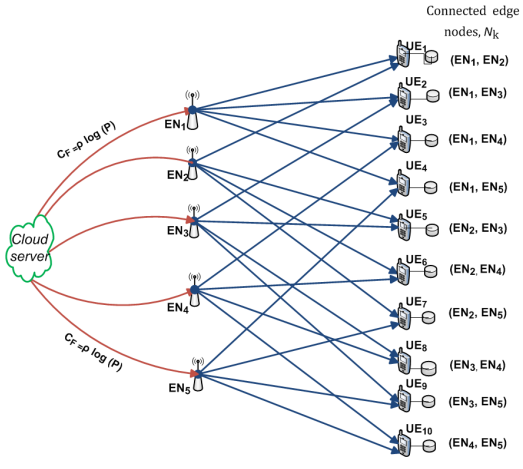
Cache-Aided Combination Networks with Interference
Centralized coded caching and delivery is studied for a radio access combination network (RACN), whereby a set of H edge nodes (ENs), connected to a cloud server via orthogonal fronthaul links with limited capacity, serve a total of K user equipments (UEs) over wireless links. The cloud server is assumed to hold a library of N files, each of size F bits; and each user, equipped with a cache of size μ R N F bits, is connected to a distinct set of r ENs each of which equipped with a cache of size μTNF bits, where μT , μ R in [{0,1}] are the fractional cache capacities of the UEs and the ENs
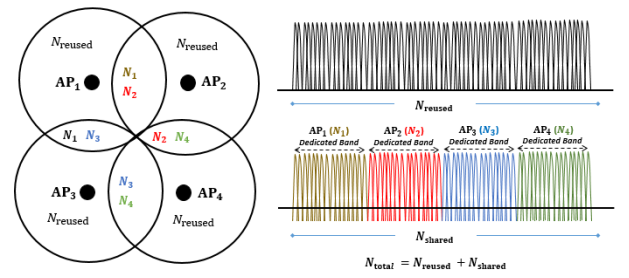
Resource allocation for throughput enhancement in cellular shared relay networks
The downlink frame of a cellular relay network is considered, where a shared MIMO decode-and-froward relaying is used to serve the users at the edge of the cell. The relay employs zero-forcing beamforming to manage the interference among the mobile stations (MSs) at the edge of the cell. A non-cooperative scheme is considered where there is no coordination between the base stations (BSs) and the relay station (RS), and a power control algorithm for the RS is developed that maximizes the rate of the relayed users. A cooperative setting which allows the coordination of a power allocation between
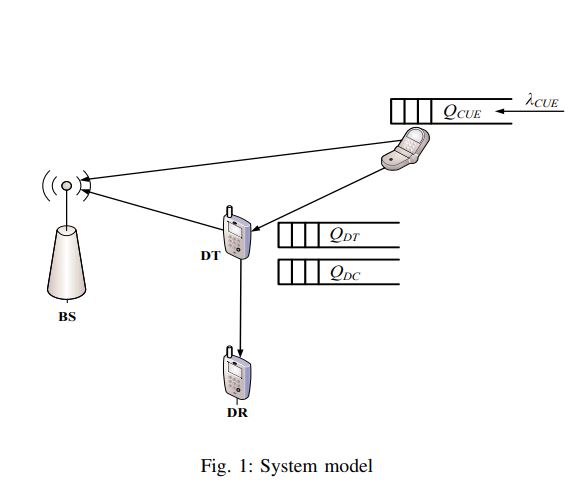
Cooperative D2D communications in the uplink of cellular networks with time and power division
Cooperative device-to-device (D2D) communication is proposed as a promising technology to improve the spectral efficiency in crowded communication networks. In this paper, we consider a transmitter-receiver pair, operating in the D2D transmission mode, overlaying the cellular network. The D2D transmitter (DT) acts as a relay for the undelivered packets of cellular user equipment (CUE). We consider the case in which the DT transmits its own data along with the relayed data using superposition coding in the uplink. We investigate how the time slot is split between the cellular network
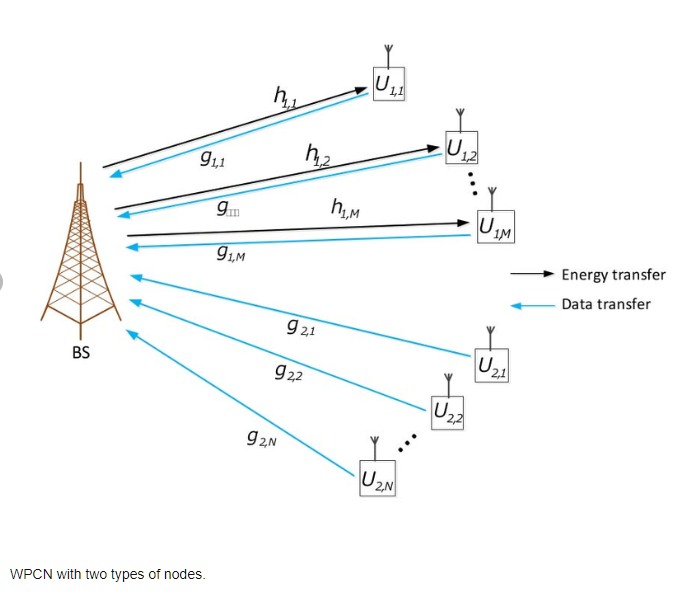
Optimization of wireless powered communication networks with heterogeneous nodes
This paper studies optimal resource allocation in a wireless powered communication network with two groups of users; one is assumed to have radio frequency (RF) energy harvesting capability and no other energy sources, while the other group has legacy nodes that are assumed not to have RF energy harvesting capability and are equipped with dedicated energy supplies. First, the base-station (BS) with a constant power supply broadcasts an energizing signal over the downlink. Afterwards, all users transmit their data independently on the uplink using time division multiple access (TDMA). We
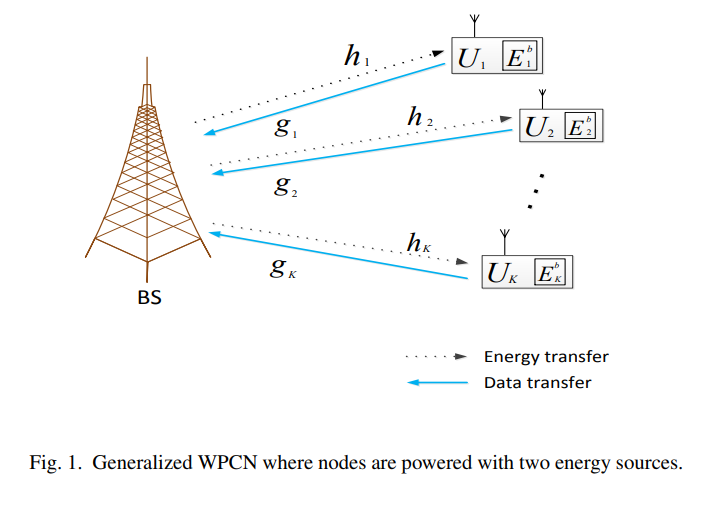
Optimization of energy-constrained wireless powered communication networks with heterogeneous nodes
In this paper, we generalize conventional time division multiple access (TDMA) wireless networks to a new type of wireless networks coined generalized wireless powered communication networks (g-WPCNs). Our prime objective is to optimize the design of g-WPCNs where nodes are equipped with radio frequency (RF) energy harvesting circuitries along with constant energy supplies. This constitutes an important step towards a generalized optimization framework for more realistic systems, beyond prior studies where nodes are solely powered by the inherently limited RF energy harvesting. Towards this