
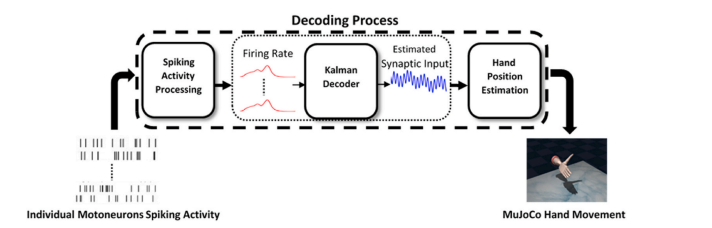
In-silico development and assessment of a Kalman filter motor decoder for prosthetic hand control
Up to 50% of amputees abandon their prostheses, partly due to rapid degradation of the control systems, which require frequent recalibration. The goal of this study was to develop a Kalman filter-based approach to decoding motoneuron activity to identify movement kinematics and thereby provide stable, long-term, accurate, real-time decoding. The Kalman filter-based decoder was examined via biologically varied datasets generated from a high-fidelity computational model of the spinal motoneuron pool. The estimated movement kinematics controlled a simulated MuJoCo prosthetic hand. This clear-box
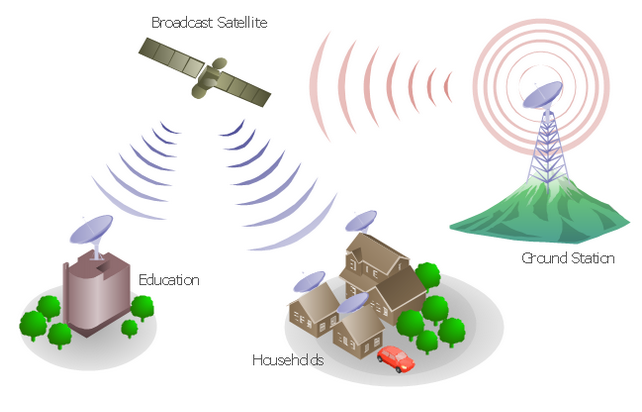
ITS navigation and live timetables for the blind based on RFID robotic localization algorithms and ZigBee broadcasting
This paper tries to alleviate some challenges facing blind and visually impaired people in public transportation systems by providing them with in-station navigation information and real-time schedule information. Novel system architecture for the Intelligent Transportation Systems (ITS) navigation for blind and visually impaired people based on recent Radio Frequency Identification (RFID) localization technologies, commonly used in robotics, is proposed. Furthermore, a live timetable using a new ZigBee network broadcasting protocol with detailed frame structure is used for provision of real
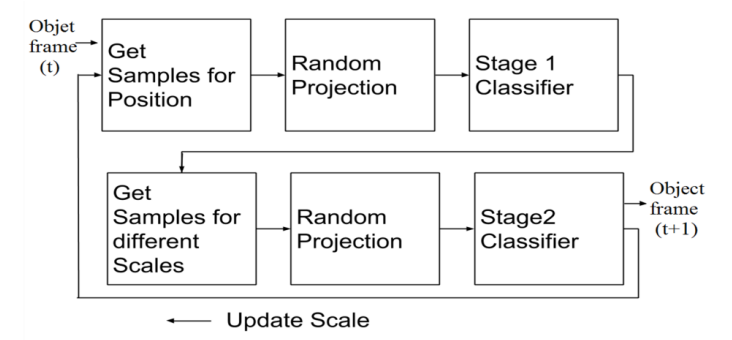
Real-time scale-adaptive compressive tracking using two classification stages
In this paper, we describe a method for Scale-Adaptive visual tracking using compressive sensing. Instead of using scale-invariant-features to estimate the object size every few frames, we use the compressed features at different scale then perform a second stage of classification to detect the best-fit scale. We describe the proposed mechanism of how we implement the Bayesian Classifier used in the algorithm and how to tune the classifier to address the scaling problem and the method of selecting the positive training samples and negative training samples of different scales. The obtained
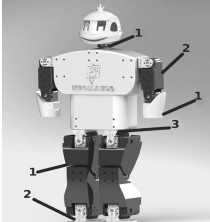
Innovative human-robot interaction for a robot tutor in biology game
Robots nowadays, are introduced to many domains and fields. One of these fields is education. We introduce integrating robots and games in education. We have designed a humanoid robot tutoring biology. Our robot is interacting with a student to play a game to enhance and examine the student's knowledge. In our game, we developed cognitive capabilities for the robot. We analyzed the features that both the robot and the game have to possess, and we developed a system for organ detection and recognition with the highest possible accuracy and lowest processing time. Our game introduces a multi

Validation of the Nonlinear Superposition Method (NSM) for elastic shakedown limit pressures via comparison with experimental test results of spherical vessels with radial and oblique nozzles
The present research revisits rare experiments which determined elastic shakedown (SD) limit pressures of full scale radial and oblique nozzles partially penetrating spherical vessels. The experiments were conducted at Berkeley Nuclear Laboratories in England [1]. The SD limit pressures were determined via conducting consecutive series of internal pressure cycles and observing cyclic strain variation recorded by strain gauges cemented at predetermined various critical locations within the junctions’ vicinities. The Nonlinear Superposition Method (NSM), formulated for computing elastic SD limit
Load carrying capacities of pressurized 90 degree miter and smooth bends subjected to monotonic in-plane and out-of-plane bending loadings
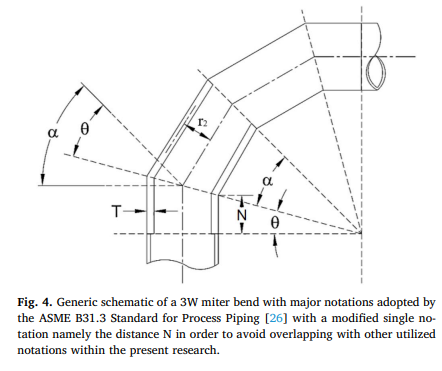
The present research focuses on generating interaction diagrams (i.e. limit moment boundaries vs steady internal pressure spectra) of pressurized 90 o miter and smooth bends. One-, two-, three-, and four-weld miter bends are modelled and analyzed. Additionally, 90 o smooth bends (SBs) bearing the miter bends’ same material and major geometric parameters are analyzed thus providing broader range of comparisons concerning structural responses to external applied loadings. All bends analyzed are subjected to steady internal pressure spectra and monotonic in-plane closing, in-plane opening, and
Effect of wall thinning on the Shakedown Interaction Diagrams of 90-degree back-to-Back Bends Subjected to Simultaneous Steady Internal Pressures and Cyclic In Plane Bending Moments
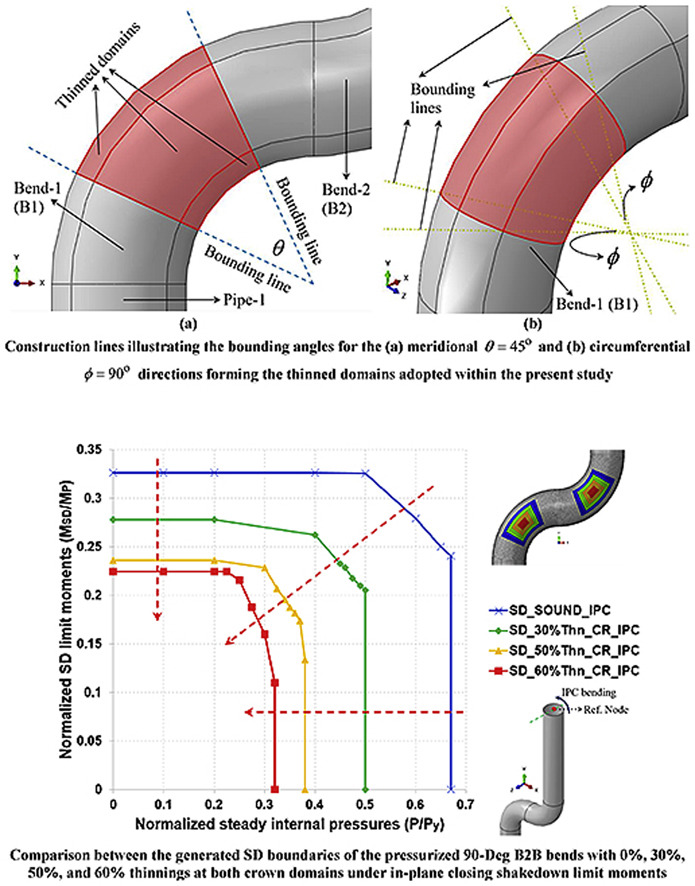
This research studies the effect of wall thinning on generated shakedown (SD) interaction diagrams of pressurized low-carbon steel 90-degree (90-Deg) back-to-back (B2B) bends. More precisely, the SD limit moments are determined for various steady internal pressure spectra thus generating the targeted SD boundaries. The SD limit moments are computed utilizing a direct non-cyclic technique termed: SD-DNT short for Shakedown-Direct Noncyclic Technique. The bends analyzed are subjected to simultaneous steady internal pressure spectra and cyclic in-plane closing (IPC) and in-plane opening (IPO)
Effect of cracks in wind turbine blades on natural frequencies during operation
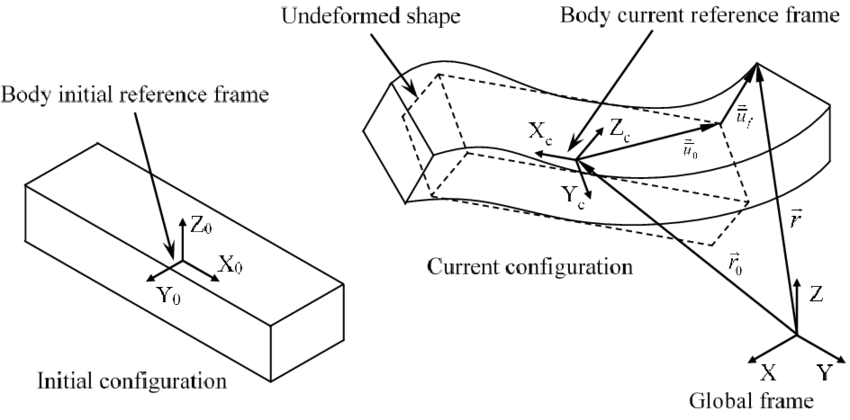
Most publications that are concerned with the crack detection via analyzing Eigenfrequencies or deformation modes of wind turbine blades (WTBs) are done in stationary condition. This paper however proposes a novel approach that could study the effect of WTB cracks during rotation at any speed without the need to stop the turbine by using multibody analysis. This approach will reduce the cost of its maintenance substantially, since it will avoid the cost of downtime for wind turbine during crack detection. This approach considers both the increase in stiffness due to rotation (known as
Dynamic behavior of polyurea composites subjected to high strain rate loading
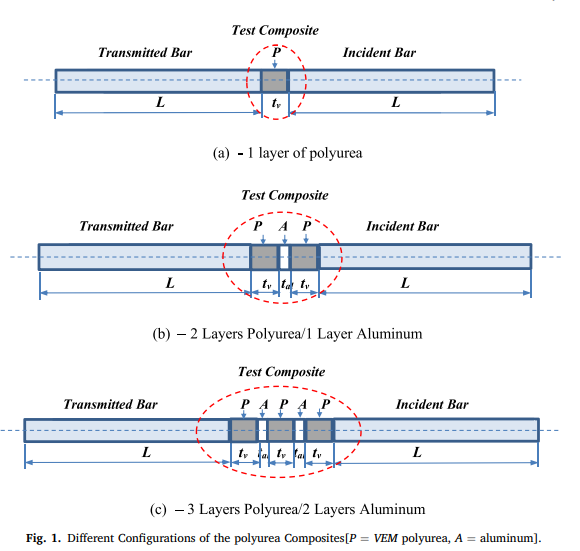
A comprehensive theoretical and experimental investigation is presented of the behavior of polyurea composites subjected to high strain-rate impact loading. The composites under consideration consist of an assembly of steel sections and inserts manufactured from layers of polyurea or polyurea augmented with aluminum layers (AL). A finite element model (FEM) is developed to predict the dynamics of this class of polyurea composites by integrating the dynamics of the solid steel sections with those of polyurea using the Golla-Hughes-Mctavish (GHM) mini-oscillator approach. The predictions of the
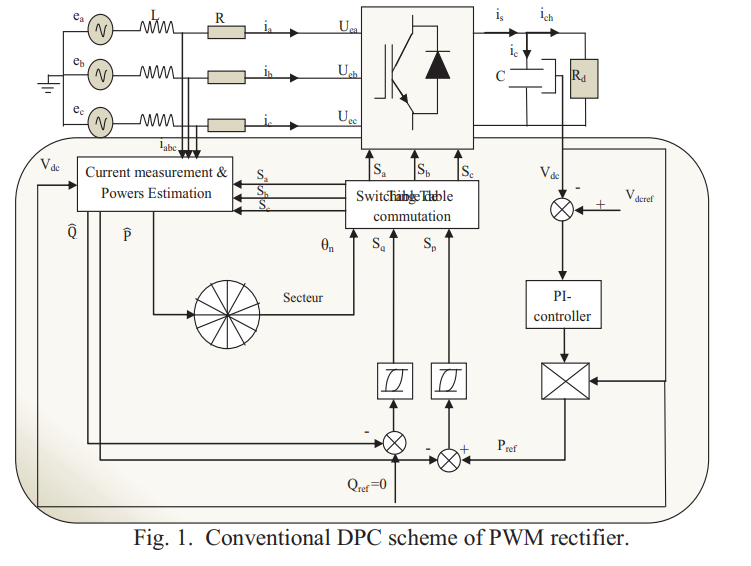
Direct Power Control of a three-phase PWM-Rectifier based on Petri nets for the selection of Switching States
This article proposes a new simple scheme for direct power control of a PWM rectifier without a switch table and voltage sensor. The selection of the switching state of the converter is based on the transition of a Petri net, using the instantaneous active and reactive power tracking errors and the angular position of the network line voltage estimated as variables of Controller input based on Petri nets. Simulation and experimental results demonstrated better performance and verified the validity of the new command with the Petri nets applied to the bridge rectifier connected to the