
Energy-efficient cooperative cognitive relaying schemes for cognitive radio networks
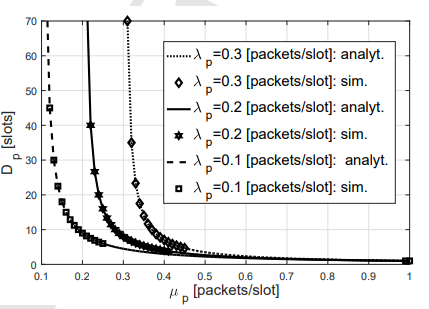
We investigate a cognitive radio network in which a primary user (PU) may cooperate with a cognitive radio user (i.e., a secondary user (SU)) for transmissions of its data packets. The PU is assumed to be a buffered node operating in a time-slotted fashion where the time is partitioned into equal-length slots. We develop two schemes which involve cooperation between primary and secondary users. To satisfy certain quality of service (QoS) requirements, users share time slot duration and channel frequency bandwidth. Moreover, the SU may leverage the primary feedback message to further increase
Stability analysis of an ordered cognitive multiple-access protocol
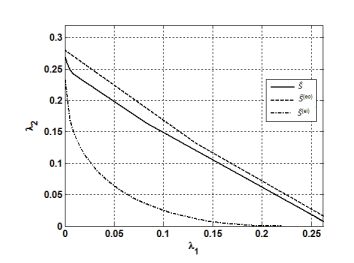
We investigate an ordered-access protocol for cognitive radios. The primary user (PU) operates in a time-slotted fashion and starts transmitting at the beginning of the time slot if its queue is nonempty. The secondary users, depending on their queues and spectrum sensing results, may start transmitting at times τ, 2τ , 3τ relative to the beginning of the time slot, where τ is the sensing duration. Secondary user j is assigned rank or order i and possibly starts transmitting at time iτ relative to the beginning of the time slot with a certain probability designed to guarantee the stability of
A probabilistic MAC for cognitive radio systems with energy harvesting nodes
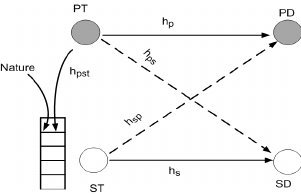
In this paper, we consider a cognitive radio (CR) system where the secondary user (SU) harvests energy from both the nature resources and the primary user (PU) radio frequency (RF) signal. We propose an energy-based probabilistic access scheme in which SU probabilistically accesses and senses the primary channel. The decision is based on the available energy and the PU's activity. We investigate the problem of maximizing the SU's success rate provided that the PU average quality of service (QoS) constraint is satisfied. We also assume multi-packet reception (MPR) capability and sensing errors
Power-optimal feedback-based random spectrum access for an energy harvesting cognitive user
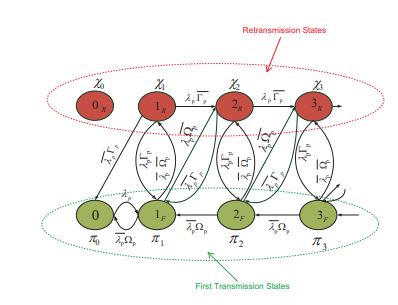
In this paper, we study and analyze cognitive radio networks in which secondary users (SUs) are equipped with energy harvesting (EH) capability. We design a random spectrum sensing and access protocol for the SU that exploits the primary link's feedback and requires less average sensing time. Unlike previous works proposed earlier in literature, we do not assume perfect feedback. Instead, we take into account the more practical possibilities of overhearing unreliable feedback signals and accommodate spectrum sensing errors. Moreover, we assume an interference-based channel model where the
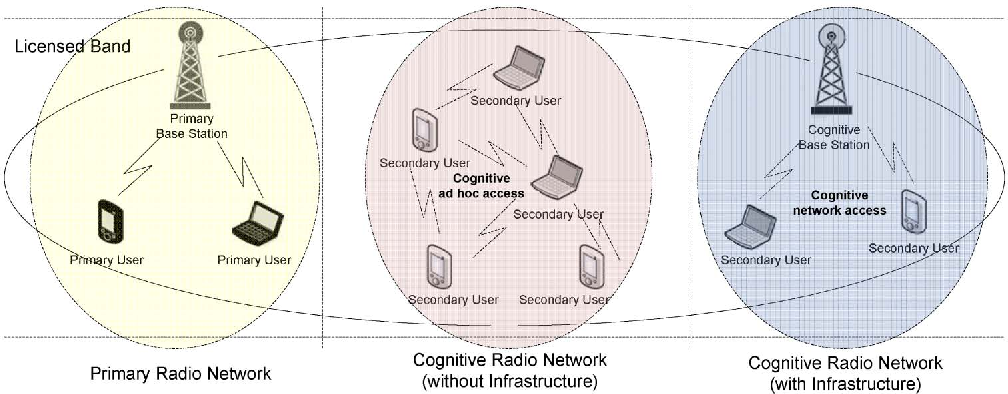
Joint power and rate scheduling for cognitive multi-access networks with imperfect sensing
A cognitive multi-access network in which a primary user and a secondary user transmit to a common receiver is considered. The secondary user senses the channel at the beginning of each time slot to determine whether the primary user is active or idle. The sensing is not perfect; hence, the secondary user can miss the detection of an active primary user or erroneously declare an idle primary user as active. The secondary user can vary its transmission rate and power from a time slot to the other. A joint rate and power scheduling algorithm is proposed that minimizes the probability of packet
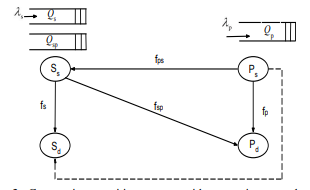
Stability analysis of a cognitive radio system with a dedicated relay
In this paper, we characterize the stability region of cognitive radio networks with a dedicated relay node. In particular, we study this system under two different MAC protocols: perfect sensing and random access. In the perfect sensing protocol, the relay node and the secondary user access the medium only when the primary user is idle. In the random access protocol, both the relay and the secondary user randomly access the medium without sensing the state of the primary user. Towards this objective, we describe the system using a queuing theoretic model and formulate a constrained
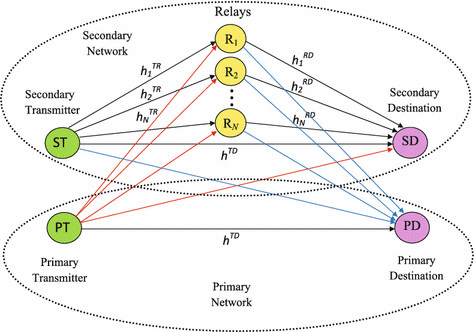
Energy-efficient cooperative relaying protocol for full-duplex cognitive radio users and delay-aware primary users
This paper considers a network in which a primary user (PU) may cooperate with a cognitive radio (CR) user for transmission of its data packets. The PU is assumed to be a buffered terminal operating in a time-slotted fashion. We develop an energy-efficient protocol that involves cooperation and coordination between primary and secondary users. To satisfy certain quality-of-service requirements, users share time slot duration and frequency bandwidth. Moreover, the secondary user (SU) may leverage the primary feedback channel. The proposed protocol is designed such that the secondary rate is
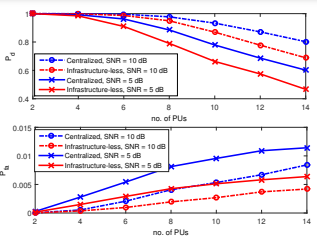
Sparse spectrum sensing in infrastructure-less cognitive radio networks via binary consensus algorithms
Compressive Sensing has been utilized in Cognitive Radio Networks (CRNs) to exploit the sparse nature of the occupation of the primary users. Also, distributed spectrum sensing has been proposed to tackle the wireless channel problems, like node or link failures, rather than the common 'centralized approach' for spectrum sensing. In this paper, we propose a distributed spectrum sensing framework based on consensus algorithms where SU nodes exchange their binary decisions to take global decisions without a fusion center to coordinate the sensing process. Each SU will share its decision with its
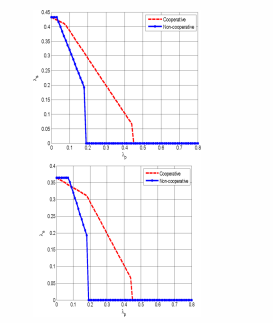
Stability analysis for multi-user cooperative cognitive radio network with energy harvesting
This paper deals with stability analysis for cognitive cooperative system composed of one primary user and many secondary users with energy harvesting imposed at both primary and secondary users. Secondary users are grouped in a cluster with a cluster supervision block (CSB) controller which controls and synchronizes all the activities of the SU cluster. The secondary user cluster is equipped with a common relay queue for collaboration with the PU. Multiple SUs cooperate with one PU for its data transmission, getting mutual benefits for both users, such that, the PU exploits SUs' power and
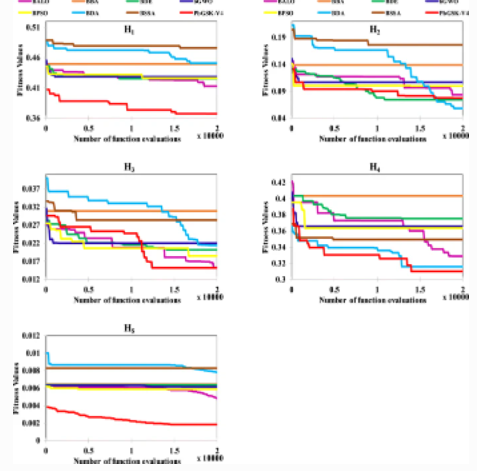
S-shaped and V-shaped gaining-sharing knowledge-based algorithm for feature selection
In machine learning, searching for the optimal feature subset from the original datasets is a very challenging and prominent task. The metaheuristic algorithms are used in finding out the relevant, important features, that enhance the classification accuracy and save the resource time. Most of the algorithms have shown excellent performance in solving feature selection problems. A recently developed metaheuristic algorithm, gaining-sharing knowledge-based optimization algorithm (GSK), is considered for finding out the optimal feature subset. GSK algorithm was proposed over continuous search