
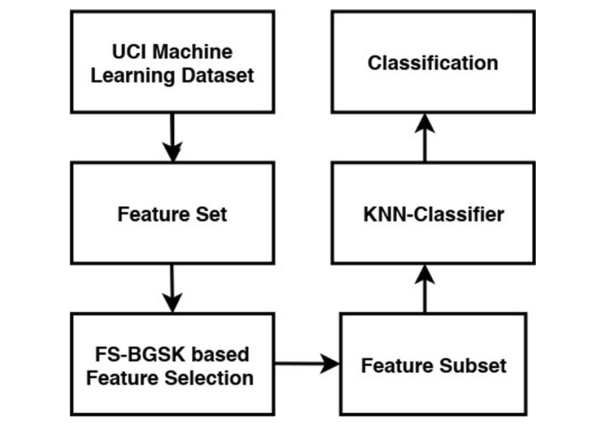
A novel binary gaining–sharing knowledge-based optimization algorithm for feature selection
To obtain the optimal set of features in feature selection problems is the most challenging and prominent problem in machine learning. Very few human-related metaheuristic algorithms were developed and solved this type of problem. It motivated us to check the performance of recently developed gaining–sharing knowledge-based optimization algorithm (GSK), which is based on the concept of gaining and sharing knowledge of humans throughout their lifespan. It depends on two stages: beginners–intermediate gaining and sharing stage and intermediate–experts gaining and sharing stage. In this study
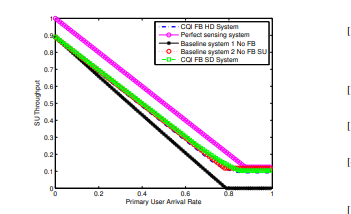
Soft-sensing CQI feedback-based access scheme in cognitive radio networks
In this paper, an access scheme for cognitive radio networks is proposed in which secondary users (SUs) make use of the primary user(s) (PUs) channel quality feedback information. SUs decide their transmission strategy based on the PUs' channel quality indicator (CQI) feedback available in the PU network and the SUs' sensing of PUs' activity. We consider two energy sensing approaches, namely, hard-sensing, and soft-sensing. An SU accesses the primary channel with access probabilities which are selected to maximize the SU service rate while ensuring PUs' quality of service requirements defined
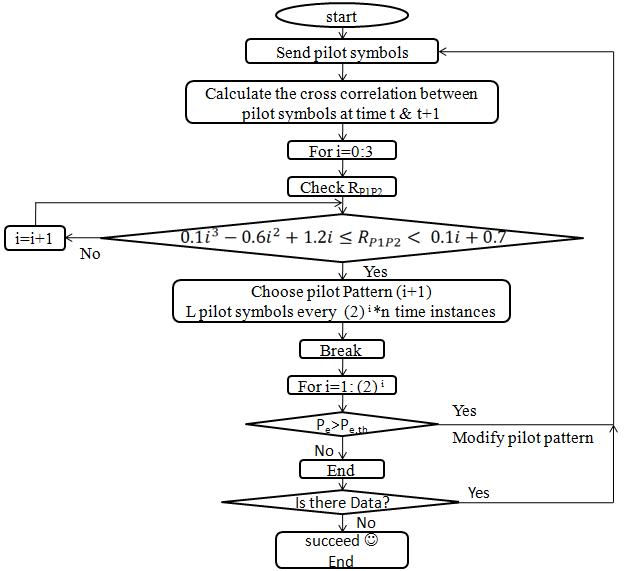
A new adaptive channel estimation for frequency selective time varying fading OFDM channels
In this paper a new algorithm for adaptive dynamic channel estimation for frequency selective time varying fading OFDM channels is proposed. The new algorithm adopts a new strategy that successfully increases OFDM symbol rate. Instead of using a fixed training pilot sequence, the proposed algorithm uses a logic controller to choose among several available training patterns. The controller choice is based on the cross-correlation between pilot symbols over two consecutive time instants (which is considered to be a suitable measure of channel stationarity) as well as the deviation from the
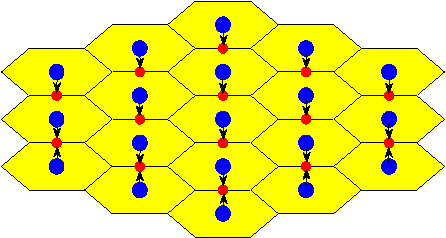
A proper throughput-leakage balance for downlink cellular networks
A novel transmission scheme is developed for the downlink frame of cellular networks. Each base station (BS) aims at iteratively balancing the throughput at the mobile stations (MSs) of its cell with the interference it causes at the MSs of the neighboring cells, requiring negligible coordination between the BSs. A simplified version of the scheme that neither requires iterations nor cooperation is also proposed. Simulation results show that the proposed schemes achieve substantial gains over well-known schemes in the literature. © 2014 IEEE.
On the coexistence of a primary user with an energy harvesting secondary user: A case of cognitive cooperation
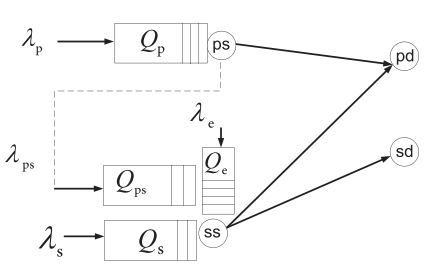
In this paper, we consider a cognitive scenario where an energy harvesting secondary user shares the spectrum with a primary user. The secondary source helps the primary source in delivering its undelivered packets during periods of silence of the primary source. The primary source has a queue for storing its data packets, whereas the secondary source has two data queues: a queue for storing its own packets and the other for storing the fraction of the undelivered primary packets accepted for relaying. The secondary source is assumed to be a battery-based node, which harvests energy packets
Achievable secrecy rate regions for the two-way wiretap channel
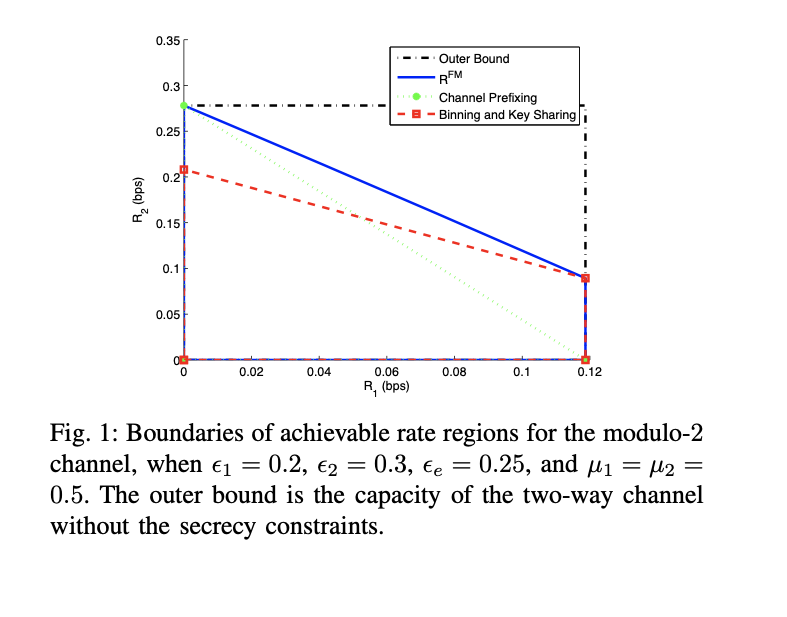
The two-way wiretap channel is considered in this paper. Two legitimate users, Alice and Bob, wish to exchange messages securely in the presence of a passive eavesdropper Eve. In the full-duplex scenario, where each node can transmit and receive simultaneously, new achievable secrecy rate regions are obtained based on the idea of allowing the two users to jointly optimize their channel prefixing distributions and binning codebooks in addition to key sharing. The new regions are shown to be strictly larger than the known ones for a wide class of discrete memoryless and Gaussian channels. In the
On orthogonal band allocation for multiuser multiband cognitive radio networks: Stability analysis
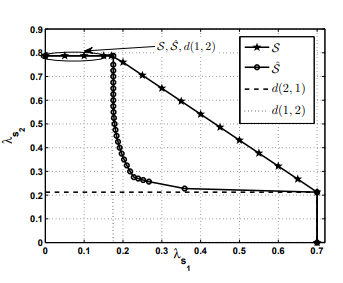
In this work, we study the problem of band allocation of Mi buffered (i.e., with data queues capable of storing incoming traffic packets) secondary users (SUs) to Mp primary frequency bands licensed to (owned by) Mp buffered primary users. The bands are assigned to SUs in an orthogonal (one-to-one) fashion, such that neither band sharing nor multiband allocations are permitted. In order to study the stability region of the secondary network, the optimization problem used to obtain the stability region's envelope (closure) is established and is shown to be a linear program, which can be solved
Using network coding to achieve the capacity of deterministic relay networks with relay messages
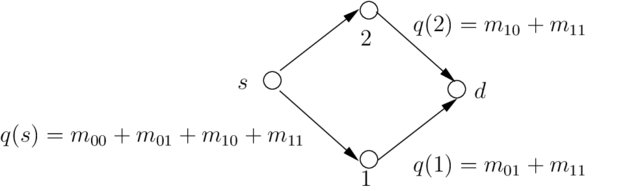
In this paper, we derive the capacity of the deterministic relay networks with relay messages. We consider a network that consists of five nodes, four of which can only communicate via the fifth one. However, the fifth node is not merely a relay as it may exchange private messages with the other network nodes. First, we develop an upper bound on the capacity region based on the notion of a single-sided genie. In the course of the achievability proof, we also derive the deterministic capacity of a four-user relay network (without private messages at the relay). The capacity achieving schemes
On spectrum sharing between energy harvesting cognitive radio users and primary users
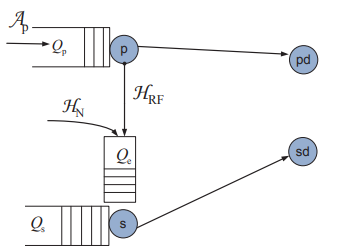
This paper investigates the maximum throughput for a rechargeable secondary user (SU) sharing the spectrum with a primary user (PU) plugged to a reliable power supply. The SU maintains a finite energy queue and harvests energy from natural resources and primary radio frequency (RF) transmissions. We propose a power allocation policy at the PU and analyze its effect on the throughput of both the PU and SU Furthermore, we study the impact of the bursty arrivals at the PU on the energy harvested by the SU from RF transmissions. Moreover, we investigate the impact of the rate of energy harvesting
On the Degrees of Freedom of the Two-Cell Two-Hop MIMO Network with Dedicated and Shared Relays
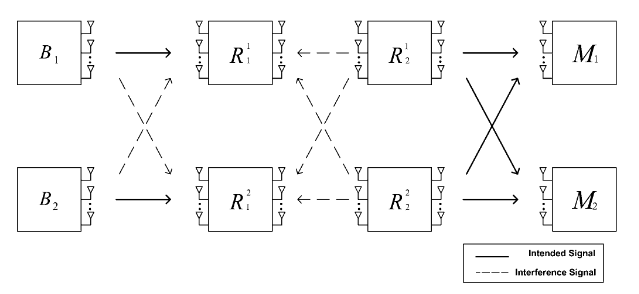
We investigate the degrees of freedom (DoF) of the downlink of a cellular relay network. In this network, two base stations transmit to two mobile stations via relays due to the absence of a direct communication link. Each base station and mobile station is equipped with M antennas. Each base station has two messages; one to each mobile station, and uses two relays to transmit to the mobile stations. The relays are half duplex, decode-and-forward and equipped with N antennas each. We consider two configurations of the relays; shared and dedicated relays. In the shared relays configuration, the